
Botox (onabotulinumtoxinA, AbbVie/Allergan Aesthetics) and Dysport (abobotulinumtoxinA, Galderma) are both FDA-cleared neuromodulators, but they differ in molecular weight, diffusion radius, onset kinetics, and unit-to-unit potency: differences that affect clinical outcomes, patient expectations, and your supply costs.
Injectables
Botox vs Dysport: Clinical Differences, Dosing, and Economics for Injectors
How onset, diffusion, unit conversion, and cost structure differ between the two leading neuromodulators, and when to stock each.
1-YEAR MOVE
ABBV
▲11.6%
| Ticker | Company | 1-year change |
|---|---|---|
| ABBV | AbbVie (Allergan Aesthetics) | +11.6% |
Free alerts
Free: recall & rule-change alerts for your practice.
Get the recalls and state-law changes that hit your treatment room, in your inbox — free. Unsubscribe in one click.
Free · weekly · unsubscribe anytime. Privacy.
| Compared | Botox | Dysport |
|---|---|---|
| Protein complex molecular weight | ~900 kDa (heavier) | ~500 kDa (lighter) |
| Diffusion radius | 0.5–1 cm (localized) | 1–1.5 cm (broader spread) |
| Onset to visible effect | 3–7 days | 24–48 hours |
| Full effect plateau | ~Day 14 | ~Day 7 |
| Typical duration | ~12 weeks | ~12 weeks |
| Unit conversion | 1 Botox unit = baseline | 3–4 Dysport units = 1 Botox unit |
| Vial sizes available | 50, 100, 200 units | 300, 500 units |
| Wholesale cost per unit | $2–3/unit (higher) | $0.50–0.75/unit (15–25% less) |
| Best for | Precision work, periorbital, brow lift, established patients | Large areas, rapid onset, high-volume practices |
The 3:1 to 4:1 Botox-to-Dysport conversion ratio reflects bioassay potency differences, not just diffusion profile—and underdosing by using 1:1 is a common error that tanks results.
The core distinction lies in the protein complex surrounding the active toxin. Botox carries a heavier protein coat (900 kDa), while Dysport's is lighter (500 kDa). This means Dysport diffuses more readily into surrounding muscle, spreading approximately 1–1.5 cm beyond the injection site versus Botox's tighter 0.5–1 cm radius. That diffusion advantage makes Dysport useful for large treatment areas (forehead, glabella) where you want broader muscle relaxation with fewer injections. Conversely, Botox's more localized spread suits precise work: periorbital lines, brow lift, or cases where you need to spare adjacent muscles.
Onset and Duration
Dysport typically shows visible softening within 24–48 hours, with full effect by day 7. Botox takes 3–7 days for initial effect and reaches plateau around day 14. For patient communication, this matters: Dysport patients see results sooner, which can improve satisfaction and referral perception. Both last roughly 12 weeks, though individual metabolism varies.
Unit Conversion and Dosing
This is where precision matters operationally. Dysport units are not 1:1 with Botox units. The standard conversion is approximately 3:1 or 4:1, meaning 1 unit of Botox ≈ 3–4 units of Dysport. A typical glabella dose of 20 Botox units converts to 60–80 Dysport units. Underdosing Dysport by using a 1:1 conversion is a common injector error that leads to poor results and patient dissatisfaction.
Why the Conversion Ratio Exists
The 3:1 to 4:1 ratio reflects differences in bioassay potency between the two products. Both toxins block acetylcholine at the neuromuscular junction, but Dysport's lighter protein complex allows faster diffusion and slightly lower per-unit potency relative to Botox's standardized reference. The ratio is not arbitrary—it's rooted in how each manufacturer's potency units are measured in mouse bioassays (LD50 testing). When you see "3:1 conversion," you're accounting for this bioassay difference, not just the diffusion profile.
In practice, some injectors find they prefer a 2.5:1 ratio for certain patients or areas, particularly if treating thin-skinned regions where Dysport's spread could cause unwanted relaxation. Conversely, high-volume practices treating thick musculature (male glabella, strong corrugators) may use a 4:1 or even 4.5:1 ratio. The conversion is a starting point, not a law; your clinical experience and patient anatomy should refine it.
Reconstitution and Stability
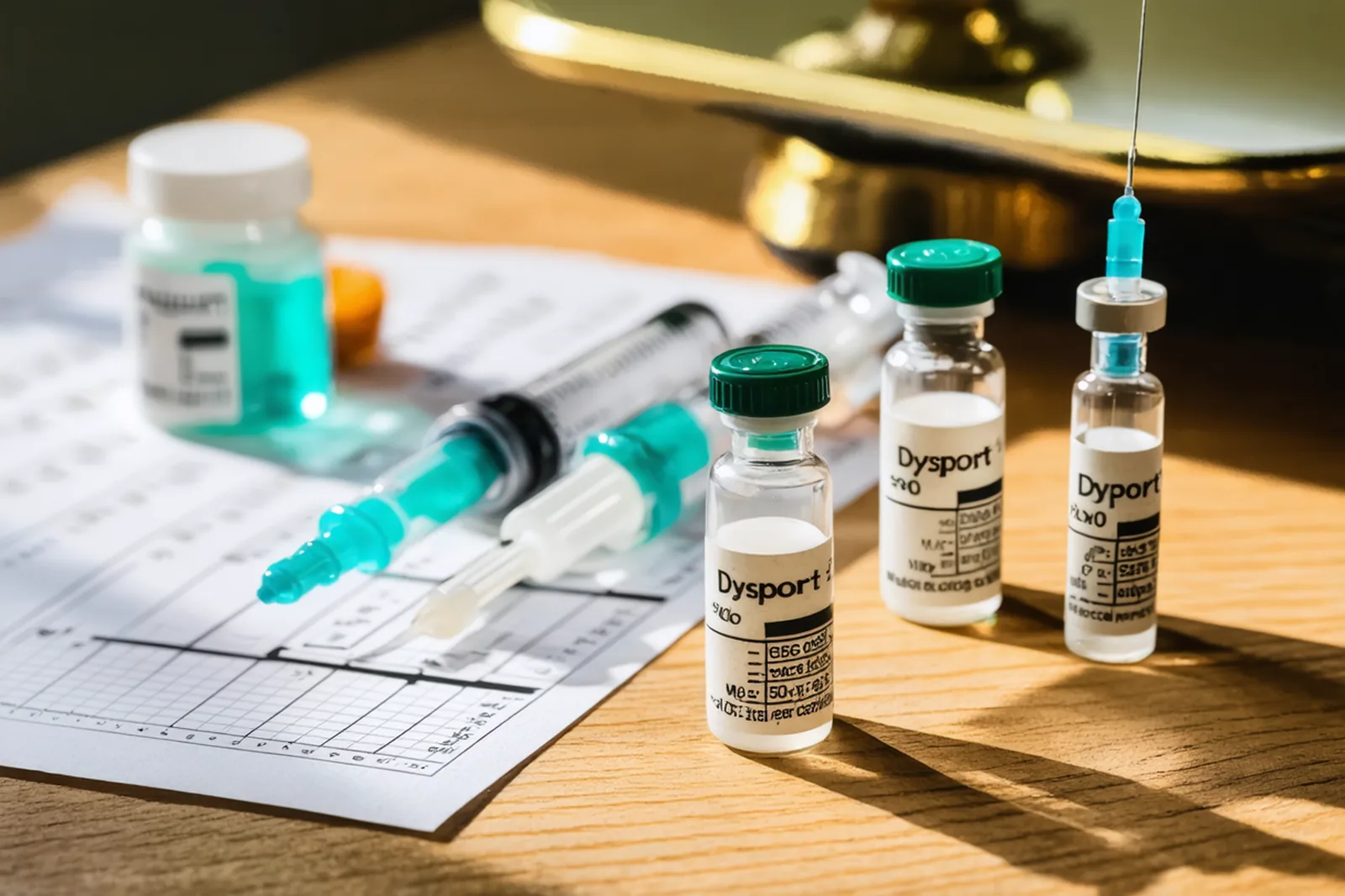
Dysport vials contain 300 or 500 units; Botox comes in 50, 100, and 200-unit vials. The 300-unit Dysport vial is popular for high-volume practices because it covers multiple treatment areas efficiently. However, Dysport's reconstitution window is tighter than Botox's: once mixed with saline, Dysport remains stable for 24 hours at room temperature, versus Botox's 4-week stability. This constraint matters operationally. If you're a lower-volume practice or have inconsistent patient flow, the 24-hour window creates waste risk. High-volume practices can move a 300-unit vial in 2–3 days, making that constraint irrelevant. Lower-volume practices may find the 100-unit Botox vial more practical despite higher per-unit cost.
Cost Structure and Economics
Dysport typically costs 15–25% less per unit than Botox at wholesale, but the unit-conversion math complicates the per-treatment comparison. A 20-unit Botox glabella treatment costs roughly $40–60 wholesale (depending on your rebate tier with Alle or Aspire); the equivalent 60–80 Dysport units runs $30–50. The savings are real but modest, usually $10–20 per treatment equivalent.
What moves the needle is loyalty rebates and volume tiers. AbbVie's Alle program and Galderma's Aspire Rewards both tier rebates based on annual spend. If you're already committed to Botox volume, switching to Dysport for marginal savings may cost you rebate tier status and negate the per-unit discount. Conversely, if you're building a practice or want to negotiate better terms, stocking both gives you leverage with your distributor.
Calculating True Per-Patient Cost
Don't compare Botox and Dysport on per-unit price alone. Calculate your actual cost per treatment by accounting for (1) wholesale unit cost after rebates, (2) the conversion ratio you use clinically, and (3) vial waste or shelf-life constraints. Example: if Botox costs you $0.12 per unit after rebates and you use 20 units per glabella treatment, your material cost is $2.40. If Dysport costs $0.08 per unit and you use 70 units (3.5:1 conversion), your material cost is $5.60—more expensive per treatment, despite cheaper per-unit pricing. Conversely, if you're treating a large forehead with Dysport's broader diffusion and can reduce total units needed, the economics flip. Track both products separately in your practice management software to see which is actually more profitable in your patient mix.
Clinical Scenarios: When to Choose Each
Choose Botox when:
- Precision is critical (lateral canthal lines, brow lift without frontalis involvement)
- Patient has had Botox before and expects predictable results
- You're treating a smaller practice with limited inventory turnover or inconsistent patient flow
- Your rebate tier with AbbVie justifies staying exclusive
- Treating thin-skinned areas where Dysport's diffusion could cause unintended relaxation of adjacent muscles
Choose Dysport when:
- Treating large surface areas (full forehead, bilateral glabella-frontalis complex) where broader diffusion reduces injection count
- Patient values rapid onset and wants to see results within 48 hours
- You have high patient volume and can move inventory before the 24-hour reconstitution window closes
- You're negotiating better pricing or want to reduce dependence on a single manufacturer
- Patient has previously had poor results with Botox and may respond better to Dysport's diffusion profile
Practical Stocking Strategy
Many high-volume practices stock both. Dysport's faster onset and broader diffusion make it the default for first-time patients seeking quick results; Botox handles retreats and precision cases. This dual approach also hedges supply-chain risk and gives you flexibility in rebate negotiations. Track your per-patient cost (including rebate recovery) and conversion rates separately for each product to know which is actually more profitable in your mix.
If you're converting an existing Botox patient to Dysport—whether for supply reasons or patient preference—communicate the conversion ratio clearly. A patient who received 20 units of Botox should expect to receive 60–80 units of Dysport for equivalent effect. Some practices include this in the patient chart or consent form to prevent confusion at follow-up visits.
Verify current pricing and rebate structures directly with your distributor or through Alle and Aspire, as these change quarterly.
Frequently asked questions
What is the unit conversion ratio between Botox and Dysport?
The standard conversion is approximately 3:1 or 4:1, meaning 1 unit of Botox equals 3–4 units of Dysport. A typical 20-unit Botox glabella treatment converts to 60–80 Dysport units. Using a 1:1 conversion is a common injector error that results in underdosing and poor patient outcomes.
How much faster does Dysport work compared to Botox?
Dysport shows visible softening within 24–48 hours and reaches full effect by day 7, while Botox takes 3–7 days for initial effect and plateaus around day 14. This faster onset can improve patient satisfaction and referral perception, making it valuable for patients seeking quicker results.
Why does Dysport diffuse more than Botox?
Dysport has a lighter protein complex (~500 kDa) compared to Botox's heavier coat (~900 kDa), allowing it to diffuse approximately 1–1.5 cm beyond the injection site versus Botox's 0.5–1 cm radius. This makes Dysport ideal for large treatment areas like the full forehead, while Botox suits precise work where you need to spare adjacent muscles.
Is Dysport cheaper than Botox per treatment?
Dysport costs 15–25% less per unit at wholesale, but accounting for unit conversion, the per-treatment savings are modest, typically $10–20 per syringe equivalent. However, loyalty rebates and volume tiers with AbbVie's Alle program or Galderma's Aspire Rewards can significantly impact true cost; switching products may cost you rebate tier status and negate per-unit discounts.
What vial sizes do Botox and Dysport come in?
Dysport vials contain 300 or 500 units, while Botox comes in 50, 100, and 200-unit vials. The 300-unit Dysport vial is popular for high-volume practices, though it requires careful reconstitution management since mixed Dysport has a 24-hour shelf life.
When should I stock Dysport instead of Botox?
Stock Dysport when treating large surface areas (full forehead, bilateral glabella-frontalis), for patients who value rapid onset, or if you have high-volume turnover. Stock Botox when precision is critical (lateral canthal lines, brow lift), for patients with prior Botox experience, or when your AbbVie rebate tier justifies staying exclusive.
Stay three moves ahead of every practice in your market.
Knowing it happened is table stakes. Inside MedSpa Pro hands you the play — what each move means for your margins, your license, and your patients, and exactly what to do about it — in a two-minute brief, twice a week. The owners who read it never get blindsided.
Get the edge · $20/moJoin the owners who run ahead of the industry. Cancel anytime, one click.