
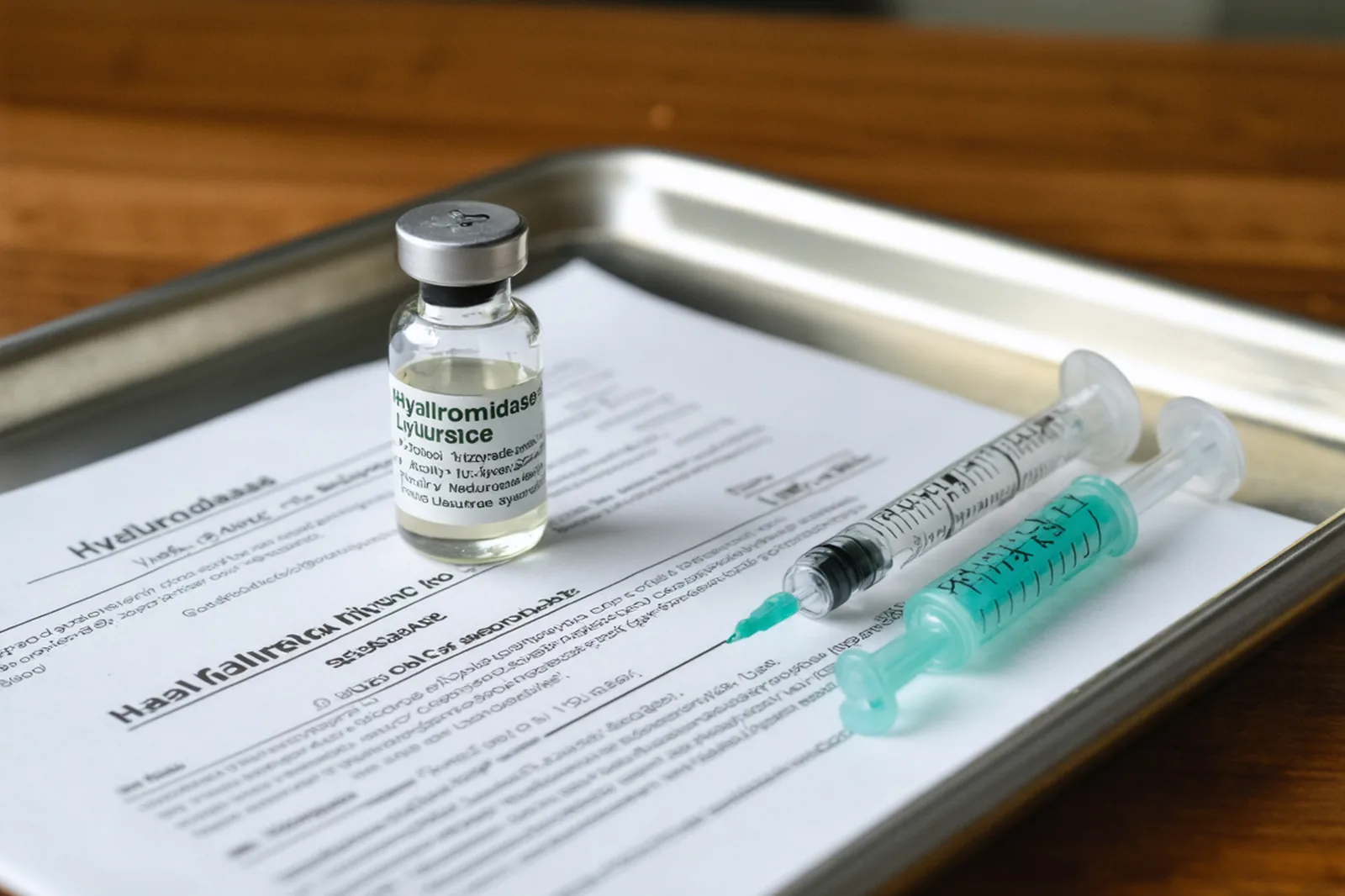
Hyaluronidase is an enzyme that catalyzes the hydrolysis of hyaluronic acid (HA), the backbone polymer in all FDA-cleared dermal fillers except calcium hydroxylapatite (CaHA) and poly-L-lactic acid (PLLA). When injected into tissue containing HA filler, hyaluronidase cleaves the glycosidic bonds between glucuronic acid and N-acetylglucosamine units, reducing the filler to smaller oligosaccharides that are rapidly absorbed by the body. The effect is visible within 24–48 hours and near-complete within 7–10 days, depending on enzyme concentration, filler crosslinking density, and tissue perfusion.
Injectables
How Hyaluronidase Dissolves Filler: Mechanism, Vascular Occlusion Protocol, and Practice Liability
Hyaluronidase breaks down hyaluronic acid filler by cleaving glycosidic bonds—and knowing when to deploy it, how to manage vascular compromise, and who bears liability is essential to practice protection.
1-YEAR MOVE
ABBV
▲11.6%
| Ticker | Company | 1-year change |
|---|---|---|
| ABBV | AbbVie (Allergan Aesthetics) | +11.6% |
Free alerts
Free: recall & rule-change alerts for your practice.
Get the recalls and state-law changes that hit your treatment room, in your inbox — free. Unsubscribe in one click.
Free · weekly · unsubscribe anytime. Privacy.
A 1.5 mL vial of hyaluronidase can dissolve 1–2 mL of filler, with heavily crosslinked products requiring repeat treatment or higher enzyme concentration.
Not all HA fillers dissolve at the same rate. Heavily crosslinked products (Voluma, Volbella, Juvederm Ultra Plus) resist hyaluronidase longer than lightly crosslinked ones (Restylane, Belotero). This is because crosslinks—covalent bonds between HA chains—must be broken before the enzyme can access the backbone. A 1.5 mL vial of hyaluronidase (typically 150 units/mL, the standard in the U.S.) can dissolve approximately 1–2 mL of filler, though heavily crosslinked material may require repeat treatment. Practitioners often dilute hyaluronidase 1:1 or 1:2 with saline to achieve precise, staged dissolution and reduce the risk of over-correction.
Vascular Occlusion: When Dissolution Becomes Urgent
Arterial or venous occlusion from filler injection is rare but catastrophic. Hyaluronidase is the only FDA-approved reversal agent for HA filler-related vascular compromise. If a patient presents with blanching, pain, skin mottling, or tissue necrosis within hours of filler injection, immediate hyaluronidase injection into and around the compromised area is the standard of care. The enzyme works best when deployed early—ideally within 12 hours, though benefit persists up to 72 hours post-injection.
The protocol: inject hyaluronidase directly into the affected tissue and adjacent areas, then apply warm compresses and consider nitroglycerin paste (topical vasodilator) and aspirin. Some practitioners add hyaluronidase to IV lines or perform intraarterial injection in severe cases, though this is off-label and carries medicolegal risk. Document the timeline, clinical signs, and all interventions meticulously; vascular events are litigation magnets.
Elective Dissolution: Patient Preference and Correction
Beyond emergencies, hyaluronidase is used for patient-requested reversal (dissatisfaction, asymmetry, overcorrection) or to correct placement errors. There is no regulatory requirement to wait a specific period before dissolving; however, best practice is to allow 2 weeks post-injection before elective dissolution to permit filler settling and to distinguish true overcorrection from post-injection edema. Dissolving too early risks unnecessary enzyme use and may not fully address the problem.
Cost to the practice: hyaluronidase vials (Vitrase, Hydase) run $50–$150 per vial depending on source and volume. Many practices bundle dissolution into their correction policy or charge $200–$500 as a separate service. Some manufacturers (Allergan, Galderma) offer hyaluronidase rebates or bundled pricing to high-volume accounts.
Liability and Scope
Hyaluronidase is not a controlled substance and does not require a separate DEA license, but it is a prescription medication. Only licensed practitioners (MD, DO, NP, PA, RN under supervision) can inject it; state scope-of-practice laws vary, so verify your state board's position. Failure to offer or deploy hyaluronidase in a vascular emergency exposes the practice to negligence claims. Conversely, injecting hyaluronidase without informed consent for elective dissolution—or without documenting the patient's request—creates liability for unintended overcorrection.
Maintain a hyaluronidase kit in your emergency supplies, train all injectors on recognition and immediate response, and document every use. Malpractice insurers expect it; state boards scrutinize its absence in adverse-event investigations.
CaHA and PLLA: No Enzymatic Reversal
Radiesse (CaHA) and Sculptra (PLLA) have no FDA-approved reversal agent. Hyaluronidase does not work on these products. If a patient has an adverse outcome with CaHA or PLLA, management is supportive (steroid injection, observation, or surgical revision in severe cases). This is a critical counseling point at consultation and a reason many practices prefer HA fillers in high-risk anatomical zones.
Hyaluronidase is a tool, not a safety net. Proper injection technique, knowledge of anatomy, and conservative dosing remain the foundation of complication prevention.
Frequently asked questions
How long does it take hyaluronidase to dissolve dermal filler?
Visible results appear within 24–48 hours, with near-complete dissolution in 7–10 days. The timeline depends on enzyme concentration, how crosslinked the filler is, and tissue blood flow. Heavily crosslinked fillers like Voluma dissolve slower than lightly crosslinked ones like Restylane.
How much filler can one vial of hyaluronidase dissolve?
A standard 1.5 mL vial of hyaluronidase (150 units/mL) can dissolve approximately 1–2 mL of filler. Heavily crosslinked material may require repeat treatment. Many practitioners dilute hyaluronidase 1:1 or 1:2 with saline for staged, precise dissolution.
What is the standard of care for filler-related vascular occlusion?
Immediate hyaluronidase injection into and around the compromised area is the standard of care for arterial or venous occlusion. Inject within 12 hours for best results, though benefit persists up to 72 hours. Follow with warm compresses, topical nitroglycerin, and aspirin; document all interventions thoroughly.
How long should you wait before dissolving filler with hyaluronidase?
Best practice is to wait 2 weeks post-injection before elective dissolution to allow filler settling and distinguish true overcorrection from post-injection edema. There is no regulatory requirement for a waiting period, but early dissolution risks unnecessary enzyme use and incomplete correction.
How much does hyaluronidase cost practices?
Hyaluronidase vials (Vitrase, Hydase) cost $50–$150 per vial depending on source and volume. Practices typically charge patients $200–$500 for dissolution as a separate service or bundle it into their correction policy. High-volume accounts may qualify for manufacturer rebates.
Who is legally allowed to inject hyaluronidase?
Only licensed practitioners—MD, DO, NP, PA, or RN under supervision—can inject hyaluronidase, which is a prescription medication. Hyaluronidase is not a controlled substance and does not require a separate DEA license, but state scope-of-practice laws vary, so verify your state board's regulations.
Stay three moves ahead of every practice in your market.
Knowing it happened is table stakes. Inside MedSpa Pro hands you the play — what each move means for your margins, your license, and your patients, and exactly what to do about it — in a two-minute brief, twice a week. The owners who read it never get blindsided.
Get the edge · $20/moJoin the owners who run ahead of the industry. Cancel anytime, one click.